
Cloud-Based Limo Software for Small Chauffeur Companies: The 2026 Guide
Published on June 15, 2026
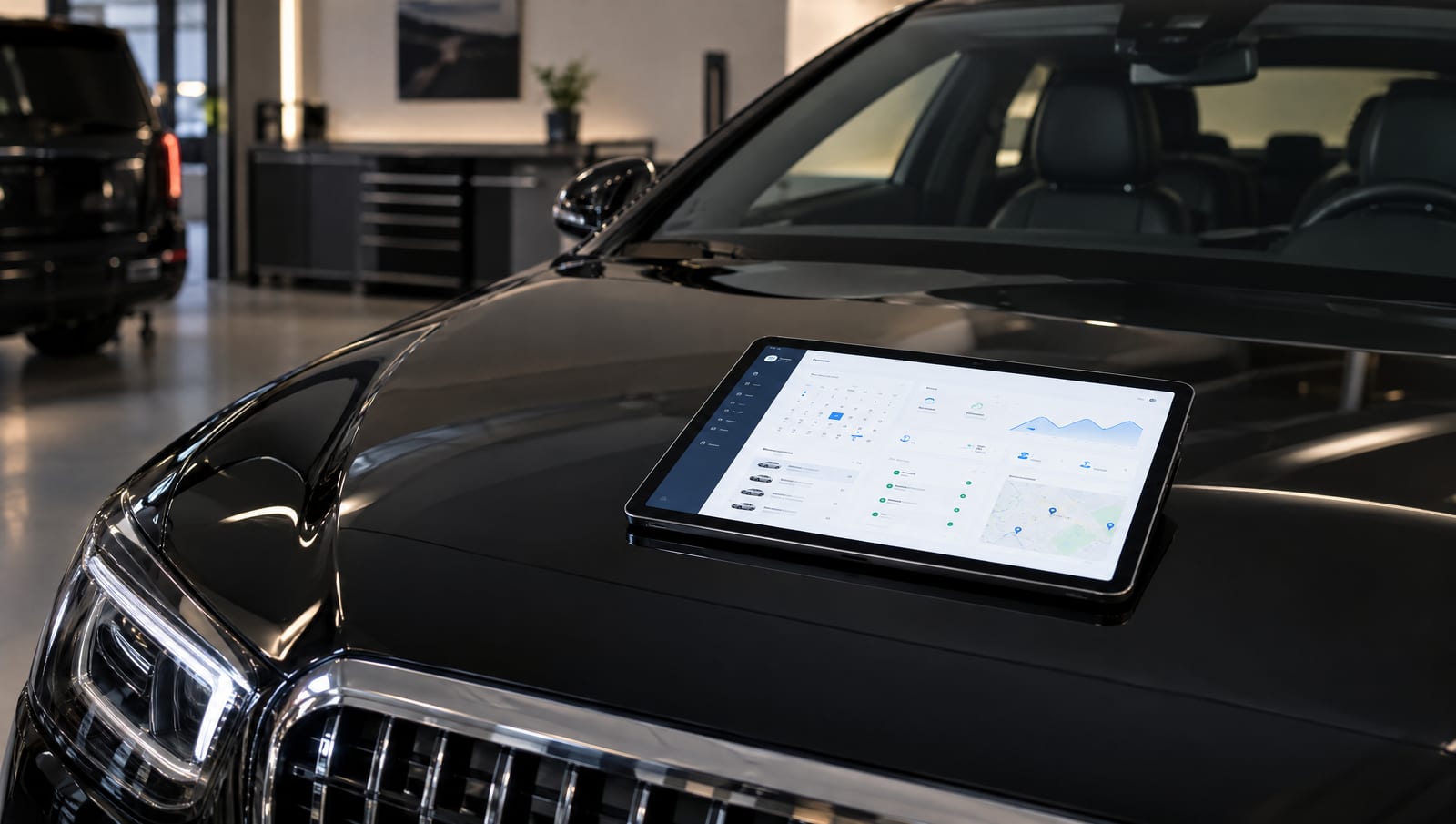
Quick answer: Cloud-based limo software is a chauffeur-management platform hosted online instead of installed on one office computer, so you can run bookings, dispatch, payments, and reporting from any device. For small chauffeur companies it’s the better choice because it costs less upfront, needs no servers or IT staff, works on a phone, and scales as you add vehicles — typically for about $40–$150 per month.
If you’re running a small chauffeur company on a desktop dispatch program from a decade ago — or worse, a phone and a spreadsheet — you’re paying for it in missed bookings and late nights. The industry has moved to the cloud, and for once the shift favors the small operator: the same tools that used to require expensive servers and an IT contractor now run from your phone for the price of a tank of fuel.
This guide explains what cloud-based limo software is, how it compares to legacy desktop systems, why it suits small chauffeur companies in particular, what it costs, whether it’s secure, and how to switch without losing your data.
What is cloud-based limo software?
Cloud-based limo software is a limousine and chauffeur management platform hosted online rather than installed on a single computer. You log in through a browser or app from any device to manage bookings, dispatch drivers, take payments, and pull reports — while updates, backups, and security are handled for you in the background.
Because nothing lives on one office machine, the business goes wherever you are. You can confirm a booking from your kitchen, dispatch a driver from an airport curb, and check today’s revenue from your phone — all from the same live system your drivers and customers are using.
How does cloud-based limo software compare to desktop systems?
The clearest way to see why operators are switching is side by side. Legacy desktop systems were built before smartphones and tie your business to one location; cloud dispatch software is built mobile-first.
| Factor | Cloud-based limo software | Desktop / legacy software | | --- | --- | --- | | Access | Any device, anywhere — office, home, or phone | Tied to one office computer | | Setup | Sign up and go live in days; no servers | Install, configure, and maintain hardware | | Updates | Automatic and included | Manual upgrades, often paid | | Upfront cost | Low monthly subscription | High one-time license plus IT costs | | Driver app | Built-in, real-time mobile app | Often none, or a clunky browser screen | | Backup & security | Encrypted and auto-backed-up in the cloud | Your responsibility; data at risk if the PC fails | | Scaling | Add vehicles, drivers, or areas instantly | Re-install and re-license to grow | | Best for | Small operators who want low cost and flexibility | Firms with dedicated IT and legacy requirements |
For a small chauffeur company with no IT department, almost every row favors the cloud. The main reason to stay on desktop is a deep dependence on legacy features or in-house IT — rare for operators under roughly 20 vehicles. To weigh specific platforms side by side, compare cloud limo software options.
Why is cloud-based limo software ideal for small chauffeur companies?
Because it gives a one- or two-person operation the capabilities of a large fleet without the overhead. The benefits that matter most to small operators:
- Low cost to start — no servers, no installs, no IT contractor. You sign up and start taking bookings, often the same week.
- Run it from anywhere — dispatch, confirm, and get paid from your phone while you’re driving, at an event, or away from the desk.
- Works 24/7 — the booking widget and driver app keep working while you sleep, so you stop losing after-hours jobs.
- Scales with you — add a vehicle, a driver, or a new service area in minutes, with no re-install or new license.
- Always up to date — new features, security patches, and integrations arrive automatically — you’re never running outdated software.
- Looks professional — a polished booking page, automated confirmations, and live tracking make a two-car company look established.
What features should small chauffeur companies expect?
A capable cloud platform for a small operator should include, at minimum:
- Online booking — an online booking widget with instant quotes for your website.
- Dispatch — a clear calendar and one-tap driver assignment.
- Driver app — a mobile app so drivers get trips, navigate, and update status.
- Payments & invoicing — card processing, automated invoicing, and clear payout terms.
- GPS & flight tracking — live vehicle tracking and flight tracking for airport runs.
- CRM & reporting — customer profiles, plus reporting that shows what’s actually profitable.
- Integrations — Google Maps, payment gateways like Stripe, and accounting tools such as QuickBooks or Xero.
How much does cloud-based limo software cost?
Cloud-based limo software for a small fleet typically costs about $40 to $150 per month on a subscription, and some providers price per vehicle. Crucially, there’s usually no large upfront license fee — the cost legacy desktop systems are known for.
When comparing prices, total the full cost, not just the headline number:
- Subscription model — flat monthly plan vs. per-vehicle pricing (cheapest with one or two cars).
- Payment processing — the card-processing rate and whether payouts are held.
- Add-ons — a branded app, extra users, SMS, or marketing services may cost extra.
- Contract terms — look for clear month-to-month terms and low upfront cost while you’re starting out.
Is cloud-based limo software secure?
Yes — for most small operators, a reputable cloud platform is more secure than a desktop system. Cloud providers protect your data with encryption, role-based access, PCI-compliant payment handling, and automatic off-site backups, with redundant servers that keep the system online.
Compare that to a legacy setup where your entire customer database sits on one office computer: if it’s lost, stolen, or its hard drive fails, so is your business. The cloud removes that single point of failure.
How do you switch from a desktop system to the cloud?
Migrating is simpler than most operators fear. A safe sequence:
- Export your data — pull your customer list, booking history, and pricing out of the old system (usually a CSV export).
- Choose with migration support — pick a cloud platform that offers migration help and confirms it can import your data.
- Import and verify — load the data and spot-check key accounts and recurring clients for accuracy.
- Train the team — get drivers onto the mobile app and walk your team through booking and dispatch.
- Run in parallel briefly — run the cloud system alongside the old one for a week so nothing slips.
- Cut over — once you trust the data and flow, move every booking to the cloud and retire the old system.
Where does LimoFlow fit?
LimoFlow is a cloud-based, all-in-one platform built specifically for limo, chauffeur, and shuttle operators — combining an online booking system, dispatch, a driver app, payments, automated invoicing, CRM, and reporting in one dashboard you can run from any device. For a small chauffeur company, that means no servers to maintain, automatic updates, and the ability to manage the whole business from your phone.
It also pairs those operational tools with marketing services (SEO, Google Ads, and websites) to keep the bookings coming in. LimoFlow works with your existing website or builds a new one, and it serves operators across the US, UK, Canada, Australia, the UAE, and beyond, with local currency and airport integrations. Guided onboarding means you’re not setting it up alone, and no technical skills are required.
Explore LimoFlow’s cloud limo software · Book a free demo · See pricing
Frequently Asked Questions
What is cloud-based limo software?
Cloud-based limo software is a chauffeur and limousine management platform hosted online rather than installed on a single office computer. Operators log in from any device to handle bookings, dispatch, payments, and reporting, with automatic updates and cloud backups.
Is cloud-based limo software good for small chauffeur companies?
Yes. It suits small operators because it has low monthly costs, needs no servers or IT staff, runs on a phone, and scales as you add vehicles. That lets a one- or two-person team run a professional operation around the clock.
How much does cloud-based limo software cost?
Cloud-based limo software for small fleets typically costs about $40 to $150 per month on a subscription, sometimes priced per vehicle. There’s usually no large upfront license fee, unlike legacy desktop systems.
Is cloud-based limo software secure?
Reputable cloud platforms use data encryption, role-based access, PCI-compliant payments, and automatic off-site backups. For most small operators that’s more secure than data stored on a single office computer that can fail or be stolen.
Can I access cloud limo software on my phone?
Yes. Cloud-based platforms are designed for mobile access, so owners can dispatch and check bookings from a phone, and drivers receive trips and update status through a mobile app.
How do I switch from desktop limo software to the cloud?
Export your customer and booking data, choose a cloud platform that offers migration support, import and verify the data, train your team on the mobile app, run both systems briefly in parallel, then cut over once the cloud system is confirmed accurate.
🚀 Want More Bookings?
LimoFlow is limo software that helps you attract leads, manage bookings, dispatch drivers, and grow your business.
Visit Homepage📱 Sign Up For Our Limo Marketing Newsletter
Sign up for SMS updates on strategies and tips to increase bookings.