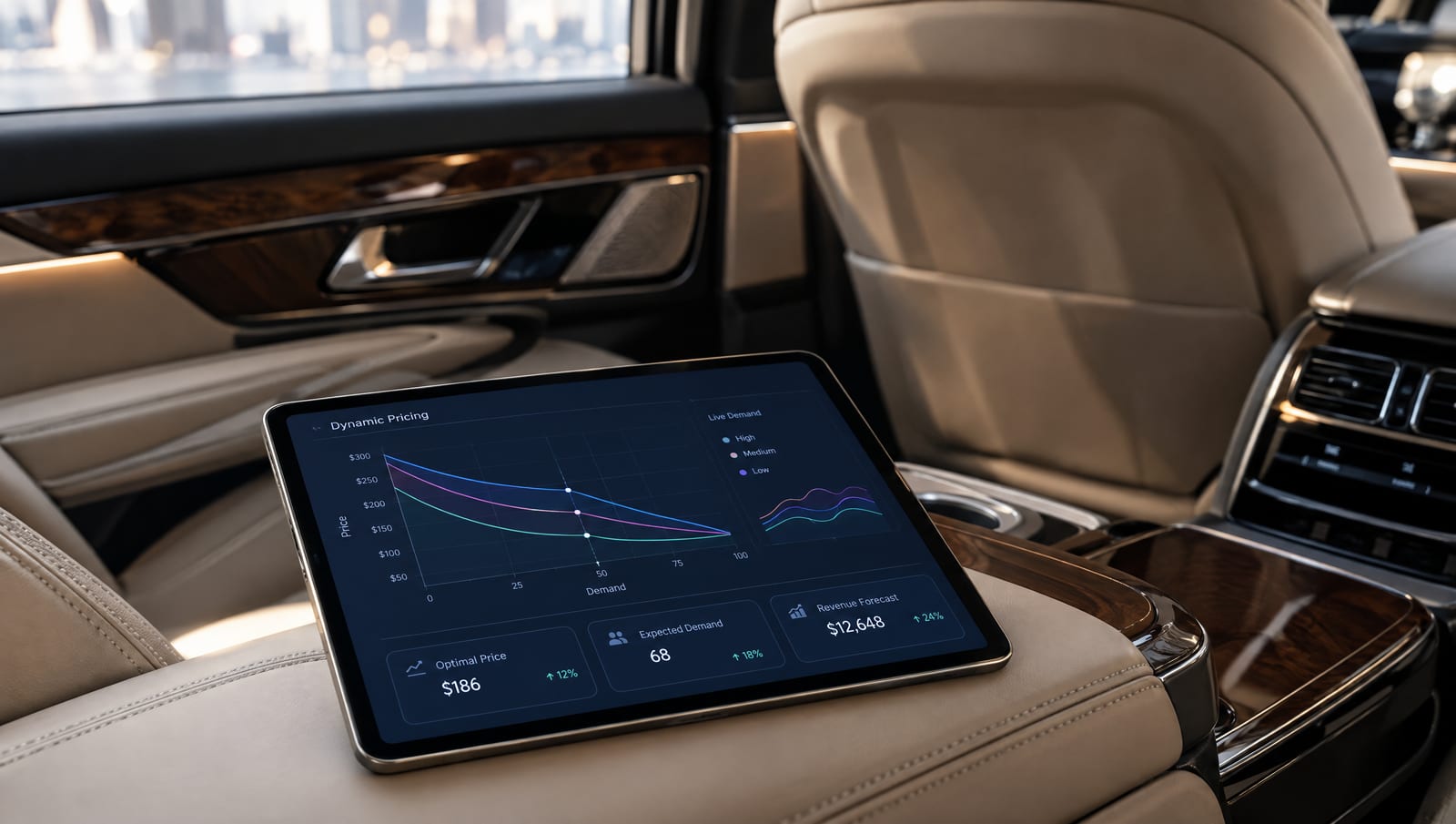
Introduction to Dynamic Pricing in Luxury Transportation
How dynamic pricing works in luxury transportation: the data inputs, AI models, pricing approaches, and trade-offs operators weigh when setting fares.

On this page
- What Data Do Dynamic Pricing Algorithms Use?
- How Does AI Power Dynamic Pricing?
- Which Dynamic Pricing Model Fits Luxury Transport?
- Case Study: How Did Uber Implement Dynamic Pricing?
- What Are the Limitations of Dynamic Pricing?
- Bottom line: Balance Revenue Optimization With Customer Acceptance
- Frequently Asked Questions
Quick answer: Dynamic pricing replaces fixed rate cards with software that adjusts fares in real time based on demand, vehicle availability, timing, and local conditions. Rates rise when demand outpaces supply and hold or fall when capacity is open. Premium operators pair demand-based pricing with zone pricing so quotes stay predictable and consistent with the brand.
Luxury transportation has moved from static rate cards to dynamic pricing algorithms that adjust fares in real time based on market conditions. The shift is more than a technology upgrade. It is a strategic response to the interplay of supply, demand, and consumer expectations in premium mobility.
Unlike traditional taxi services with fixed meters, luxury transportation providers now use algorithmic systems that continuously analyze many variables to optimize pricing, from current demand patterns and driver availability to weather conditions and local events. The algorithms behind ride pricing have grown more sophisticated, adding machine learning that adapts to market patterns and consumer behavior.
The impact goes beyond fare calculation. Dynamic pricing has changed how luxury transportation companies manage fleet utilization, driver incentives, and market positioning. It also brings new challenges around pricing transparency, consumer trust, and regulatory compliance, particularly in the luxury segment, where expectations for service quality and pricing consistency are exceptionally high.
Understanding how these pricing systems work, and what they imply, is essential as the industry continues to digitize.
What Data Do Dynamic Pricing Algorithms Use?
The effectiveness of dynamic pricing in luxury transportation depends on the quality and breadth of the data behind each algorithmic decision. Modern pricing algorithms process multiple data streams simultaneously, building a comprehensive view of market conditions that enables real-time price optimization.
Real-time demand indicators form the primary data layer, including current booking requests, wait times, and rider density patterns across geographic zones. Supply-side metrics such as vehicle availability, driver locations, and fleet utilization rates counterbalance demand signals, letting algorithms identify supply-demand imbalances that justify price adjustments.
Historical data patterns add context, including seasonal trends, event-driven demand spikes, and time-of-day variations that help predict future demand curves. Weather, traffic congestion, and special events add more variables that sophisticated algorithms factor into pricing calculations.
External market factors increasingly influence luxury transportation pricing, including competitor rates, local economic indicators, and regulatory constraints. Advanced algorithms also incorporate customer behavioral data, analyzing booking patterns, price sensitivity, and service preferences to optimize both revenue and customer satisfaction. This multi-dimensional approach lets algorithms respond to market conditions while maintaining the service quality that defines luxury transportation. The challenge is determining which inputs most accurately predict customers' willingness to pay at different price points.
What Is Price Elasticity in Demand-Based Pricing?
Price elasticity is the cornerstone of effective dynamic pricing, because it determines how sensitive customers are to price changes under different market conditions. Unlike standard transportation services, luxury offerings often show inelastic demand during peak periods, so operators can make significant price adjustments without proportional drops in demand. The concept of surge pricing, popularized by ride-sharing platforms, shows how demand-based pricing responds to real-time conditions.
Luxury services face unique elasticity challenges, though, because their clientele typically prioritizes service quality and availability over cost. Research indicates that luxury customers tolerate premium pricing better during high-demand periods, particularly for time-sensitive travel or special events.
Understanding demand curves is crucial when segmenting luxury markets. Business travelers often show different elasticity patterns than leisure customers, with corporate account clients less price sensitive during weekday peak hours. Special event transportation, such as weddings or galas, shows highly inelastic demand, so operators can capture premium pricing without significant booking losses.
Effective demand-based pricing needs continuous calibration of elasticity assumptions. Luxury operators must balance revenue maximization with brand positioning, because excessive price volatility can erode the premium perception that justifies their market position.
How Does AI Power Dynamic Pricing?
Artificial intelligence has changed how luxury transportation services implement dynamic pricing, moving beyond simple supply-demand calculations to machine learning algorithms that process vast datasets in real time. Modern AI systems can analyze hundreds of variables at once, from weather patterns and local events to individual customer behavior and competitor pricing strategies.
Neural networks form the backbone of the most advanced pricing systems, enabling predictions that anticipate demand fluctuations before they occur. These systems learn from historical patterns while adapting to emerging trends, so their models grow more accurate over time. For luxury transportation operators, that means optimized revenue streams and better service availability during peak periods.
The infrastructure behind ride-hailing pricing now handles millions of calculations per second across global markets. Cloud-based processing platforms enable real-time price adjustments that respond to micro-market conditions, while APIs connect pricing engines to customer-facing applications.
The complexity of AI-driven pricing also raises concerns about algorithmic transparency and potential market manipulation. Research indicates that sophisticated algorithms can inadvertently create pricing patterns that disadvantage certain consumer segments, raising questions about fairness in automated decision-making.
These technological foundations matter when evaluating different dynamic pricing models and their practical applications across luxury transportation.
Which Dynamic Pricing Model Fits Luxury Transport?
Luxury transportation services use several distinct dynamic pricing approaches, each with its own advantages and implementation complexity. Understanding them helps operators choose the framework that suits their market conditions and service objectives.
Surge-based models, popularized by ride-sharing platforms, multiply base rates by predetermined factors during peak demand. They are simple and transparent but can create sudden price spikes that luxury customers may find jarring. Continuous optimization models, in contrast, adjust prices incrementally from real-time data streams, giving smoother price transitions that fit premium service expectations.
Time-based pricing models segment demand by predictable patterns such as morning commutes, evening events, or seasonal fluctuations. They respond less quickly than real-time systems but give customers more price predictability, which research indicates is particularly valued in luxury segments where planning and budgeting are priorities. Competition-responsive models add competitor pricing data to demand signals to stay competitive while protecting profit margins. Equitable pricing considerations, however, must be balanced against pure profit optimization, particularly in markets serving diverse socioeconomic segments.
The most sophisticated luxury operators increasingly adopt hybrid approaches, combining elements of several models into nuanced pricing strategies that respond to market conditions while preserving brand positioning and customer relationships. For practical steps, see how to implement dynamic pricing effectively and how to build dynamic rate cards for different markets. Real-world implementations show how these models play out.
Case Study: How Did Uber Implement Dynamic Pricing?
Uber’s implementation of real-time pricing represents one of the most extensively studied examples of dynamic pricing success in luxury transportation. The company’s surge pricing algorithm demonstrates how sophisticated pricing models can balance supply and demand while maintaining service quality during peak periods.
The platform’s approach combines multiple data streams to adjust pricing instantaneously. A Deeper Look at Uber’s Dynamic Pricing Model reveals that the system processes location-specific demand patterns, driver availability, and historical traffic data to calculate pricing multipliers. During high-demand events like New Year’s Eve or major concerts, the algorithm can increase prices by 200-400% to incentivize more drivers to enter the network.
The results proved transformative for market efficiency. Within minutes of price increases, driver supply typically expanded by 15-30% in affected zones. Simultaneously, demand moderated as price-sensitive customers opted for alternative transportation or delayed their trips. This dynamic equilibrium maintained service availability when traditional taxi services often disappeared entirely during peak periods.
The key success factor was transparency in pricing communication. Rather than hiding price increases, Uber prominently displays surge multipliers and estimated costs before booking confirmation. This approach built consumer trust while allowing the algorithm to function effectively, though it also highlights potential challenges that warrant careful consideration in implementation strategies.
What Are the Limitations of Dynamic Pricing?
Demand-based pricing offers significant advantages for luxury transportation services, but several limitations must be addressed during implementation. Consumer acceptance remains a primary challenge, particularly when prices rise during high-demand periods such as severe weather or emergencies.
Algorithmic transparency is another significant consideration. Unlike traditional pricing, dynamic algorithms can create a perception of unfairness when customers receive different quotes for identical routes within short timeframes. Research indicates that consumer trust decreases when pricing mechanisms appear opaque or discriminatory.
Regulatory compliance adds complexity. Transportation authorities increasingly scrutinize algorithmic pricing, with some jurisdictions capping surge multipliers or requiring advance notification of price changes. Legal scholars highlight concerns about potential consumer harm from automated pricing systems.
Technical limitations also constrain effectiveness. Data quality issues, system latency, and integration challenges with existing booking platforms can undermine algorithmic precision. Market volatility during extreme events may cause algorithms to overcorrect, producing prices that drive customers away instead of optimizing revenue.
These considerations underscore the importance of balanced implementation that prioritizes both profitability and customer satisfaction.
Bottom line: Balance Revenue Optimization With Customer Acceptance
Dynamic pricing algorithms are a fundamental shift in how luxury transportation services operate, turning static fare structures into responsive supply-demand pricing that adapts to real-time market conditions. The evidence shows that successful implementation requires sophisticated machine learning models that process multiple data streams at once, from traffic patterns and weather conditions to historical demand trends and competitor pricing.
The most critical insight is the balance between revenue optimization and customer acceptance. Algorithms can theoretically maximize profit through precise demand prediction, but practical implementation must account for consumer psychology and competitive positioning. Transparency is crucial: successful operators explain their pricing mechanisms instead of treating algorithms as black boxes.
The technology's limitations matter just as much. Algorithmic bias, regulatory compliance challenges, and the complexity of luxury service differentiation all constrain implementation. The most effective approaches combine automated pricing with human oversight, so algorithms enhance strategic decision-making rather than replace it.
As the luxury transportation sector evolves, dynamic pricing will likely become standard practice, balancing operational efficiency with customer satisfaction, but success will depend on thoughtful implementation that balances technological capability with customer experience and regulatory requirements.
For ground-transportation operators, LimoFlow includes zone-based pricing on every plan and dynamic pricing on Essential and higher plans, so these strategies can be applied without stitching together separate tools. Operators comparing options can browse the limo software directory to see how such features are packaged, or see how LimoFlow's pricing engine handles dynamic pricing for peak periods and events.
Frequently Asked Questions
How do transportation pricing algorithms determine real-time rates?
Modern transportation pricing algorithms use machine learning models that process multiple data streams at once, analyzing current demand patterns, driver availability, traffic conditions, and historical data to calculate optimal prices in real time. The algorithms continuously adjust rates based on supply-demand imbalances, with some platforms updating prices every few minutes during peak periods.
Are dynamic pricing practices regulated in the luxury transportation sector?
Currently, most jurisdictions have limited specific regulations governing algorithmic pricing in transportation services. Regulatory scrutiny is increasing, however, as consumer protection agencies examine potential algorithmic harm and anti-competitive practices, so luxury operators should monitor evolving compliance requirements and adopt transparent pricing policies.
Can customers predict when surge pricing will occur?
Exact predictions remain challenging, but surge pricing typically follows predictable patterns during major events, weather emergencies, and rush hours. Many operators now provide advance notifications or price estimates to help customers make informed booking decisions.
Can limousine and black car operators apply dynamic pricing?
Yes. LimoFlow includes zone-based pricing on every plan and dynamic pricing on Essential and higher plans, so operators can set rates that shift with demand, time of day, or service area while keeping quotes predictable for corporate accounts. You can compare limo dispatch and pricing software or book a demo to see how it works in practice.
Sign Up For Our Limo Marketing Newsletter
Sign up for SMS updates on strategies and tips to increase bookings.